
GREAT Curriculum @ DG - Overview
CURRICULUM INTENT AND VISION
The principles of curriculum planning are underpinned by our dedication to providing an engaging, inclusive and ambitious experience for all our students. Creativity is at the heart of Deptford Green; we want it to be the golden thread that runs throughout our curriculum and approaches to teaching and learning. We also want all Deptford Green students to experience a curriculum that they see themselves in, thrive in classrooms, and feel a sense of belonging to the school and the wider community. We have a particular focus on supporting students who experience disadvantage and are dedicated to ensuring equity for all, securing good oracy, literacy, numeracy and preparing students for their future lives.
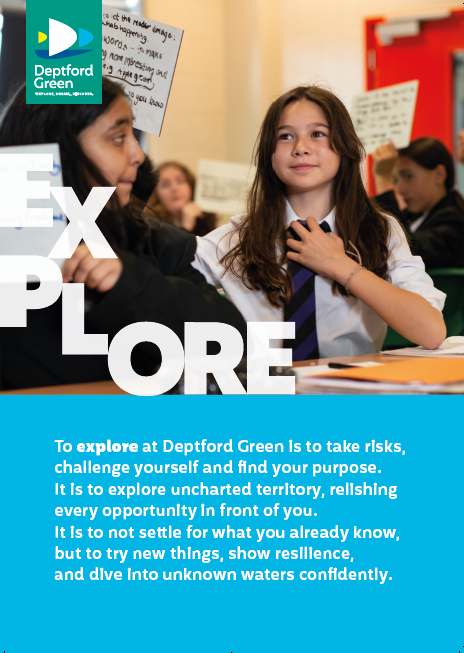
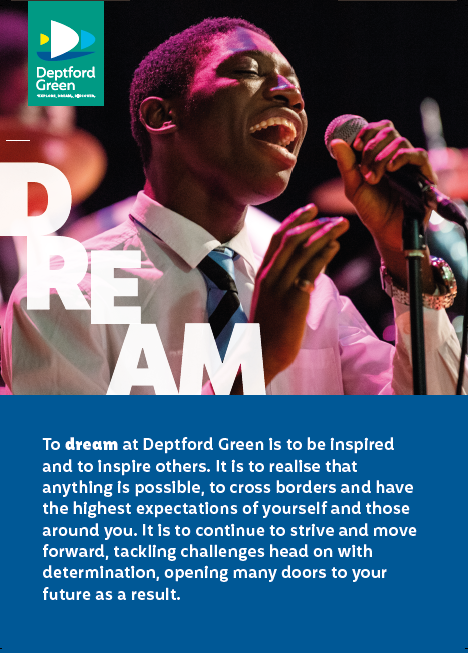
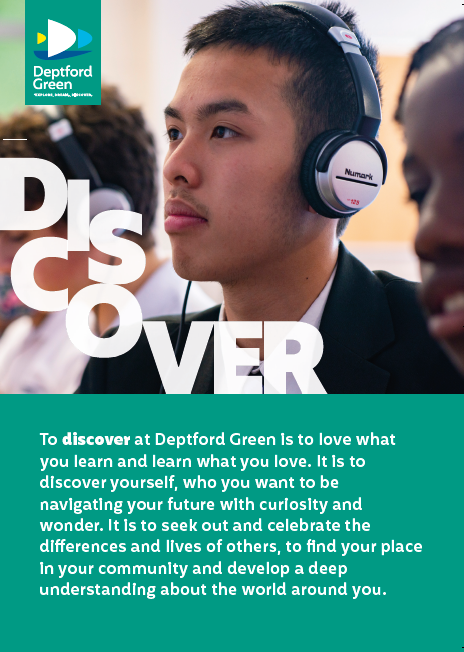
We are extremely proud of the rich and diverse curriculum we have created and pride ourselves on delivering lessons in a structured, engaging and creative way in line with recent research. At the heart of the curriculum is our dedication to ensuring learning is accessible and challenging for all, allowing all our students to explore, dream and discover.
CURRICULUM IMPLEMENTATION
Each subject curriculum is sequenced to ensure that students secure and revisit knowledge, allowing them to develop an excellent understanding of a variety of subjects.
SUBSTANTIVE |
PROCEDURAL |
DISCIPLINARY |
|
Substantive knowledge is the understanding of the core facts, concepts, principles, and content within a particular subject or discipline -basically what is known in that field. |
Procedural knowledge is the understanding of how to do something, the skills, methods, techniques, and processes used to perform tasks or solve problems. | Disciplinary knowledge is the understanding of how a particular field creates, evaluates, and validates knowledge - its methods, rules, conventions, and ways of thinking. |
RETRIEVALRetrieval is the process of actively recalling information from memory, rather than simply re-reading or re-exposing oneself to it. It is important because bringing knowledge to mind strengthens memory, improves long-term retention, and helps learners apply what they know in new contexts. |
SUBJECT SPECIFIC VOCABULARYSubject-specific vocabulary refers to the words and terms that are unique to, or have specialised meanings within, a particular subject area. |
OUR CURRICULUM:
-
is mapped so that teachers understand what knowledge should be taught, and when it should be taught. The different needs of students and classes are always taken into consideration.
-
is taught in a clear sequence that allows for the development of substantive, procedural and disciplinary knowledge. We check students have secure foundational knowledge, and plan lessons that allow students to build on and develop their prior knowledge.
-
ensures that what is taught is challenging for all and provides students with regular opportunities to problem-solve and use critical thinking skills.
-
builds in regular opportunities to revise and retrieve previously learnt content to improve retention of knowledge into long-term memory.
-
Provides opportunities for students to use subject specific vocabulary.
-
provides regular opportunities for oracy.
-
has clear assessment points which allow students to independently practice and demonstrate their understanding following a sequence of lessons.
DISCOVERY DAY
On a Tuesday, the Year 9 timetable is given over to Creative and Performing Arts, giving students the opportunity to be immersed in a range of Arts subjects, including Drama, Music, Textiles, Art and Photography. The structure of Discovery Days also allows students to focus on fewer disciplines as the year goes on, to allow them more time to develop their knowledge and skills in these subjects. Significant final pieces and performances are then presented at the end of the year. Discovery Days have led to a significant increase in students choosing arts-based subjects at Key Stage 4.
CAREERS AND PSHE
The statutory requirements for Careers Education and Sex Relationship Education are provided with a comprehensive programme for each year group. Citizenship, work-related learning and financial capability are integrated across the curriculum. Enrichment activities are provided to enhance and broaden students’ learning at Deptford Green School. These take place in school and during trips and visits.
A wide range of extra curriculum activities are available for all students. The purpose of such activities is to enhance and offer a broader curriculum offer beyond the classroom. The aim being to widen students’ cultural capital, sense of achievement, social skills, wellbeing and enjoyment.
KEY STAGE 3
A three-year Key Stage 3 provides students with time and space to gain secure understanding. It builds on the National Curriculum Key stage 2 programme of study and bridges gaps in learning with personalised programmes for identified students. English, Mathematics, Science, PE, Geography, History, RE/ethics, Modern Foreign Languages (Spanish or French), Computing and PSHE. In Year 7, CATs (Cognitive Abilities Tests) are used to gain an understanding of students’ baselines in a number of areas, and the Bedrock programme is used to establish reading ages of all students. This data, along with Key Stage 2 results, is used to shape students' learning journey.
KEY STAGE 4
The Key Stage 4 curriculum meets the needs of students by incorporating the opportunity to study both academic and vocational courses, alongside an extensive arts offer. We are passionate about our broad and balanced curriculum, putting students at the centre of it. Our aim is to give each student the chance to succeed by offering an appropriate range of qualification, opening doors to post-16 courses, employment and their future lives.
The Key Stage 4 programme of study commences in Year 10. By the end of Year 9, each student formally selects optional GCSE subjects to study in Years 10 and 11 to supplement the core GCSE subjects. A small amount of students follow a vocational course as an alternative to one GCSE subject. Students participate in one week of work experience by the end of year 10.
Post 16 guidance is provided to enable students to choose relevant courses or training when they leave Deptford Green.
For more details on the Key Stage 4 options, please visit the Pathways pages, where you can get a full breakdown of all courses.
IMPACT
Students are assessed formatively through 'hinge assignments' which assess students' application skills following a sequence of lessons. Summative assessment also takes place through internal and external examinations. For more details about the assessment process, please visit the Assessment page.
If you have any queries about the curriculum, please contact Mr Allen – tallen@deptfordgreen.co.uk